Easter being one of the most important holidays in Greece, we highly suggest to Greece holiday lovers to live this experience at least once. Specially when it falls later in Spring and you have more chances of enjoying the sea as well. Easter is considered to mark the passing of winter to
spring. but this year Orthodox Easter is at the end of April beginning of May. In Greece, Easter is celebrated with an entire week of festivities with Good Friday, Easter Sunday, and Easter Monday being celebrated as public holidays.
Good Friday is considered to be a sacred day in Greece. The day starts
out with local young girls and women decorating a replica (or “epitaph”)
of Christ’s funeral bier with flowers. This is then marched through the
streets of the village following an
evening mass entitled “The Epitaph Mass.”
Easter Saturday is known as the The Resurrection or “Anastasis”.
Preparations for the jovial dinner begin early in the morning with the
cooking of the maghiritsa- a type of soup. The faithful begin to gather
at churches and squares of the cities and villages before 11 p.m.,
carrying large white candles. Before midnight, the lights of the
churches are put out in symbolism of the darkness that Christ had to
endure as he passed through the underworld.
At midnight, a priest appears holding a lighted candle taper reciting
the phrase “Avto to Fos”, which means “This is the light.” His candle,
dubbed “the Holy candle”, is used to light several of the onlookers’
candles, which in turn then light their neighbour’s candles.


This
continues until the entire square is lit with flickering candle light.
The lighting of the candles is said to be the most significant moment of
the entire year.
The resurrection is proclaimed at exactly midnight, and is celebrated
with drums, fireworks, and church bells. Fireworks light up the sky in a
majestic display.
The crowd offers the salutation
“Christós Anésti”
(Christ has risen) to each other, which is responded to with the phrase
“Alithós Anésti” (He has truly risen). They then dissipate; returning to
their homes to the previously laid festive tables and break their fast
with the traditional soup, maghiritsa. Before entering their homes, they
make the symbol of a cross in the air with the smoke of the candle
above the door. Devout followers are said to light an oil candle inside
the home beside their icon-candle and keep this light burning throughout
the year. It is said that if you can make it home without your candle
going out, you will have a good year.
After the traditional dinner, the family and friends that gathered for dinner will
crack red eggs.
The game symbolizes resurrection and new life. Easter eggs are dyed red
to exemplify the blood of the Christ. The hard shell of the egg is said
to replicate the sealed tomb of Christ. Cracking the egg illustrates
the resurrection. The rules of the game, called tsougrisma, are as
follows:
Two players select a red egg. Each holds their egg and one taps
the end of the other’s egg with theirs lightly. The goal is to crack the
other’s egg without being forceful. Once an egg is cracked, the winner
uses the same end of their red egg to crack the other end of their
opponent’s egg. The winner is said to have good luck all year long.
The atmosphere on Easter Saturday is one of joy- family and friends
gather for a momentous event that turns into a festive dinner party that
often times will last long into the night.
Despite being up throughout the evening for the jubilant Resurrection
feast, everyone is up early the next morning to prepare for the Easter
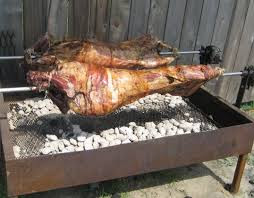
Sunday dinner. The most celebrated of the Holy Week, Easter Sunday is a
feast of lamb served in honour of the lamb of God. The lamb is usually
roasted on a spit outside, and the entire day is celebrated with food,
wine, music, friends, and lots of dancing.
Religious customs throughout the Easter celebrations have remained
unchanged over centuries, being passed from generation to generation.
Easter brings together several aspects of cultural influences of the
nation for a beautiful week of celebration and commemoration of the
religious and political histories of Grecian culture. Visitors to Greece
during this time of year will bear witness to a sacred and magnificent
time celebrating the resurrection of the body of Christ, as well as the
symbolic end of winter and beginning of spring. Hints of Venetian and
pagan influences combine with Orthodox Christianity and Roman
Catholicism to bring you a truly touching experience. Grecian Easter
carries not only a deeply rooted religious facet, but also a magical
quality of the first signs of spring.
Traditional dances in the heart of the village
https://www.youtube.com/watch?v=IcB_F7kjOj4
and on Sunday if you want to live the real "GLENDI" (celebration) you can go to the little harbor. highly suggest to reserve a table in advance
https://www.youtube.com/watch?v=MLYao-Vuuqo
for more info on Easter on Paros you might want to visit the following pages
https://www.facebook.com/video.php?v=338063743071640
https://www.facebook.com/video.php?v=271129216431760
http://www.huffingtonpost.com/michael-schuermann/a-unique-easter-tradition_b_5182131.html
http://www.grreporter.info/en/easter_island_paros_exciting_atmosphere_against_background_aegean_sea/9187
For reservation contact me by email at
secretgardenparos@yahoo.gr
 The sea, quite warm still! with the advantage of having any beach you choose all to yourself.